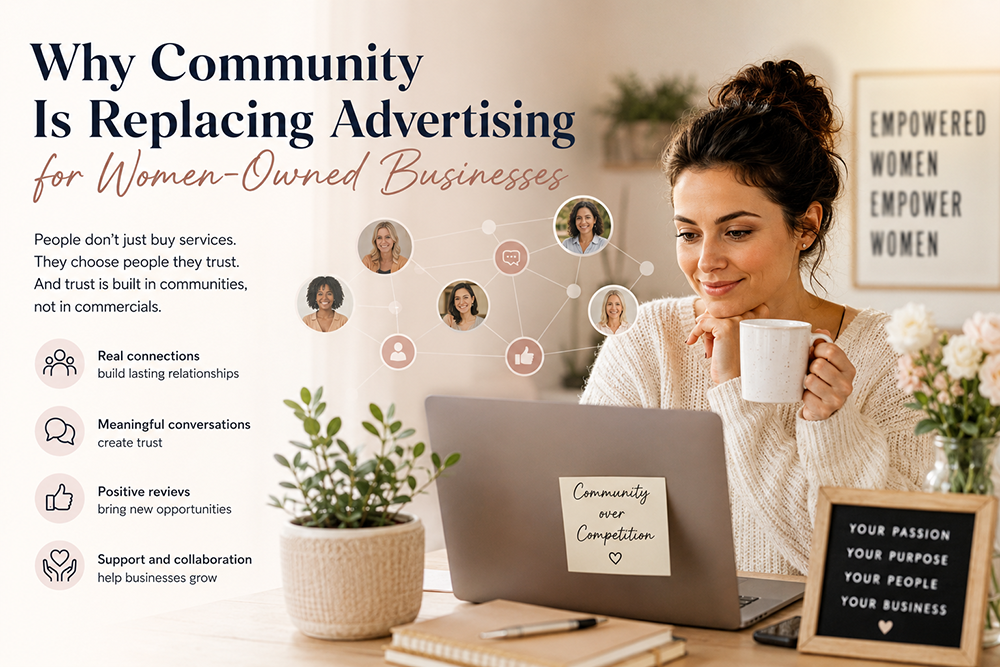
There is a quiet shift happening in small business, and most people haven’t noticed it yet.
For decades, success was often measured by the size of a company’s advertising budget. Businesses competed for bigger newspaper ads, better billboard locations, more radio airtime, and later, more clicks and impressions online. The assumption was simple: the more people saw your business, the more customers you would attract.
That strategy still works for many products. It works for retail stores, restaurants, and large brands that need visibility above everything else.
But a different reality exists for millions of women who have built businesses around their knowledge, experience, and personal relationships.
A psychologist is not simply offering therapy sessions. A real estate agent is not just selling homes. A financial consultant is not only explaining investment strategies, and a nutrition coach is not merely creating meal plans. In every one of these professions, the service is deeply connected to the individual providing it. Long before money changes hands, clients are making a much more personal decision.
They are deciding whether they trust the person standing behind the business.
That single change has quietly transformed the way many women entrepreneurs grow their companies.
Unlike traditional businesses, many women-owned businesses are built around one individual. The founder answers the phone, meets with clients, writes social media posts, responds to emails, manages appointments, and delivers the service itself. There is no marketing department carefully crafting a corporate image. The business and the person become almost impossible to separate.
This creates both a challenge and an opportunity.
Large companies can spend thousands of dollars every month to remain visible. Independent professionals rarely have that luxury. More importantly, visibility alone is often not enough. A customer looking for a therapist, a tutor, or a business coach isn’t simply searching for a service. They’re looking for someone who understands them, someone they feel comfortable speaking with, and someone they believe can genuinely help.
That kind of confidence cannot be purchased with advertising.
It develops gradually through dozens of small interactions.
A thoughtful answer to a question.
A helpful article.
A recommendation from an existing client.
A sincere response to a review.
A photo from a recent project.
A useful tip shared without asking for anything in return.
Each interaction is small on its own, but together they create something advertising has always struggled to deliver: genuine trust.
This is one of the reasons community-driven platforms are becoming increasingly important for independent professionals. Instead of asking businesses to constantly buy more exposure, these platforms allow them to build relationships over time. Every conversation, every review, every shared experience becomes another opportunity to demonstrate professionalism and expertise.
For many women entrepreneurs, this approach feels natural because it reflects the way they have always built their businesses. Growth often comes through conversations rather than campaigns, recommendations rather than promotions, and long-term relationships rather than one-time transactions.
Goodviser was created with this changing landscape in mind. Rather than functioning as another online directory where businesses simply list their name and phone number, the platform encourages ongoing interaction. Business owners can answer questions, publish updates, collect reviews, share their expertise, and communicate directly with potential clients. Over time, their profile becomes more than a listing—it becomes a living representation of their professional reputation.
Perhaps this is why community is becoming more valuable than advertising for so many independent professionals. People no longer choose a business based solely on who appears first in search results. They increasingly choose the person who feels familiar, knowledgeable, responsive, and trustworthy.
In a world where technology continues to automate almost everything, human connection may become the one competitive advantage that cannot be copied. And for thousands of women building businesses around their expertise, that advantage is already proving to be more powerful than advertising itself.