Fun Yards
Gardening
Tacoma / WA / US
 0 (0)
0 (0)
0 followers
Artificial turf today serves as a worthy decoration in landscape design. It is used to adorn areas around homes, spacious lawns, sports fields, and occasionally small individual territories, often combined with other garden decorations. The wide assortment of such turf provides ample opportunities for landscaping, but it is crucial to know how to choose the right material and how to care for it.
Advantages and Disadvantages of Artificial Grass
Artificial grass coverings have been around for over half a century, and over time, their characteristics have significantly improved. Various types of synthetic grass and corresponding installation methods have emerged.
Artificial lawns offer numerous advantages over natural ones, including a presentable appearance. When you acquire synthetic coverage, you immediately know how beautifully the landscaped area will look. In the case of planting natural grass, the final result may not be as attractive, requiring reseeding, corrections, and so on.
Other advantages include simplicity and speed of installation, a long service life (lasting up to 5 to 15 years with proper installation), cost-effective landscaping and maintenance, the ability to create a beautiful lawn in areas with limited sunlight, stain resistance allowing sitting or lying on it without a mat, and the option to choose creative designs, such as grass imitating pink or red.
However, the coverage also has its drawbacks. High-quality artificial grass can be relatively expensive. In hot weather, synthetic lawns can become quite hot, causing discomfort. Not all artificial grass can be recycled, negatively impacting the planet's ecology.
Characteristics of Artificial Turf for Landscape Design
Artificial turf consists of fiber with a grass-like appearance, simulating natural green grass. The fibers can differ in shade, length, and stiffness, depending on the material used in their production.
A standard covering comprises three layers: the bottom layer serves as a base for integrity and strength, ensuring water drainage; the middle layer contributes to cushioning and the lawn's durability, with variations including sand, a mix of sand and rubber crumbs, or no layer at all - a preference in landscape design; the top layer consists of synthetic fibers resistant to wear and environmental factors, typically made from polypropylene or polyethylene.
Varieties
When choosing artificial grass, understanding its intended use and purpose is crucial. This determines the type to consider when making a purchase. Covers are conventionally classified as filled, unfilled, or semi-filled.
Non-filled
Non-filled turf is recommended for decorative purposes in landscaping. Its characteristic feature is that the fibers most realistically mimic natural grass but are highly susceptible to mechanical impact. It is called non-filled because the space between the fibers is usually not filled with anything. In rare cases, a small amount of quartz sand may be present.
Semi-filled
Semi-filled coverage has a complete filling with one component – quartz sand. Such a surface has more practical properties, including high strength. This type of coverage has a wide range of applications and is often used for sports or children's playgrounds, as it can cushion falls.
Filled
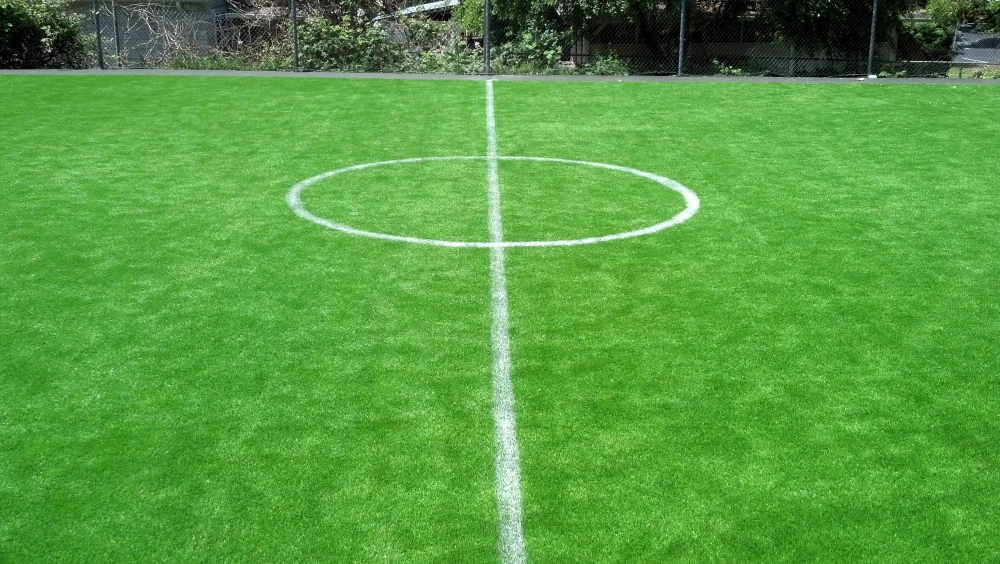
Filled artificial turf is exclusively suitable for areas subjected to heavy loads. The inter-fiber layer consists of quartz sand and rubber crumbs, providing good resistance to mechanical impact and minimizing slipping. Football fields are typically covered with such turf.
How to Choose the Right One
To choose the right type of turf covering, carefully study the characteristics and decide which color will best suit the area. You can purchase coverage in stores, online shops, or directly from the manufacturer. Ideally, you should have the opportunity to "feel" the material in person. Quality coverage may come at a higher cost but will last a long time. Pay attention to products from recognized manufacturers.
Also, pay attention to:
1. Matte fibers have a longer service life.
2. A covering that closely matches the color of natural grass harmonizes well in landscape design.
3. Fibers should be soft but also have a certain elasticity, providing resistance to mechanical impact.
4. Choose coverage where there is the highest number of tufts per square meter – this helps hide problem areas in the landscape.
5. The length of the fiber should correspond to the operating conditions. If you plan to place roll turf in a non-trafficked area, you can choose material with longer fibers.
Caring for Artificial Turf
Artificial turf requires care. While it is much easier than caring for natural grass – no need to mow, water, etc. – some rules need to be followed:
1. Periodically remove fallen leaves with a rake.
2. Wash the coverage every two weeks to remove deep dirt.
3. If the turf is filled or semi-filled, it is necessary to replenish the infill 1–2 times a year.
4. During severe frosts, it is not recommended to remove snow from the turf, as it can damage the covering. Snow cover should only be removed when the temperature becomes positive again.
Artificial grass in landscaping serves as an excellent alternative to natural grass. It requires fewer care measures, can adorn both sunny and shady areas, and significantly enlivens the territory in the fall-winter period. The key is not to skimp and acquire high-quality material that delights with its decorative qualities and durability.
0 Likes
